MARKER DEDICATION: SATURDAY, AUG 8, 2026





Dedication Speakers
Marisa Scheinfeld, Marker Project, grew up in Rock Hill
Isaac Jeffreys and Louis Ingilterra, Marker Project
Sullivan County Historian John Conway
Naomi Jaffe: Naomi Jaffe is the granddaughter of Simon Jaffe, founding rabbi of Congregation Anshei Glen Wild, and a member of the extended Jaffe Family which operated a hotel, rooming house, bungalow colony and poultry farm on a 48 acre farm at the corner of Glen Wild Road and Adams Road from 1919 to 1971. The farm remained in the family until was sold last year. An exhibit of artifacts from the 100-year-old hotel can be seen in the hotel section of the Sullivan County Historical Society Museum in Hurleyville. Naomi is retired and currently lives in Troy, NY.
*This project is made possible with funds from the Statewide Community Regrant Program, a program of the New York State Council on the Arts with the support of the Office of the Governor and the New York State Legislature and administered by Delaware Valley Arts Alliance. Additional support generously provided by Sullivan Catskills.
The Jaffe House, Glen Wild, NY
Hotel, Rooming House, Bungalow Colony, and Poultry Farm, 1919-2024 by Naomi Jaffe
Shimon Jaffe came straight to the hamlet of Glen Wild, NY as a newly ordained Yeshiva student from Minsk, Lithuania in 1904. Two years later, he was joined by his wife, Rivl. The tiny Jewish community had arranged with him by mail to serve their spiritual needs – conducting prayer services, weddings, funerals, circumcisions, the children’s Jewish studies, and most of all kosher chicken butchering. The community couldn’t afford a salary, so he was paid by the piece. He presided over the founding of Congregation Anshei Glen Wild in 1913, and the construction of the Congregation Anshei Glen Wild synagogue 10 years later.
Shimon and Rivl had four children – Sadie, Abe, Dave, and Berl (who was killed by a hit and run driver at the age of 12 in 1928). They struggled to make ends meet on Shimon’s irregular pay. They saved and borrowed about $4000 and in 1919 bought the house that became the Jaffe House Hotel, so they could supplement their income by taking in summer vacationers. The 48-acre property was part of the farm of Yana Gerson, the first Jewish farmer in the Catskills.
Shimon and Rivl turned the house of 15 small rooms into a modest hotel. Throughout the 1920’s and 30’s, working class Jewish families from New York City came in the summer to enjoy “the mountain air.” Each small room had two iron bedsteads, a chair, a dresser, and a washbasin. The toilet was in the hall, and the showers and laundry sink were in an outbuilding. On the first floor were the dining room and children’s dining room. In summers when the rooms were all rented, the Jaffe children slept in the barn.
In the 1930’s, Shimon, Rivl, and their children built two bungalows and an annex with five small apartments, each with its own little kitchen (the sign on the front tree said “Modern Apartments – Refrigerators”). They converted the hotel into a rooming house with a shared “community kitchen” where the guests did their own cooking.
When the Jaffes’ oldest son, Abe, lost his job as a ladies’ underwear cutter in New York City in the crash of 1929, he came home to Glen Wild, built two small chicken coops and started a poultry farm alongside the hotel.
Abe, together with his brother Dave, operated the poultry farm, rooming house, and bungalow colony through the 1950’s, until summer tourism in the Catskills became unprofitable. They added a hatchery and grew to a large 30,000-chicken operation which they ran until the biggest coop burned in 1971. The elders retired from farming and lived out the rest of their lives on the farm. It continued to be owned by the Jaffe family until it was sold in 2024, having been home to four generations of Jaffes for 125 years.
.jpg/:/rs=w:400,cg:true,m)
Remembering Glen Wild
Recollections of Naomi Jaffe
Across the intersection of Glen Wild Road and Adams Road from the Jaffe House stood Cantor and Greenberg's Bungalows, known locally as C & G's. Naomi remembers it as a small bungalow colony of about six cabins stretching along Adams Road, with a grocery store and ice cream counter at the corner.
The grocery carried only a handful of essentials—you could ask for a can of peas or beans, but not much else. The ice cream counter was a favorite gathering spot, where a stick of licorice cost a penny and an ice cream cone with sprinkles cost ten cents. One summer, to the outrage of neighborhood children, the owners added an extra penny for the sprinkles.
Behind the bungalows, steps descended into Glen Wild (Fowlwood) Brook, where concrete walls created a simple swimming area. "It was a little fancier than ours," Naomi recalls, "because it had walls like a swimming pool, even though the brook flowed right through it."
The pinball machine at C & G's became a favorite hangout for teenagers, second only to slipping through a well-known path in the woods into the Rock Hill Drive-In Theatre, where local kids watched movies they could barely hear without the car speakers.
Heading north on Glen Wild Road was Berlin's Bungalows. Nearby were the bungalow colonies of Oscar Hack, Ben Hack, and the Hecht family. Like many bungalow owners, they spent summers in Glen Wild alongside their guests before returning to New York City each fall.
For children, summers revolved around the brook, ice cream cones, climbing an apple tree that doubled as a spaceship, and occasional rides in the back of Abe's farm pickup truck along the back roads. Every so often, a traveling carnival ride—such as the Whip—would arrive on a trailer and set up in a nearby field, drawing children from bungalow colonies throughout the area for a ten-cent ride.
At the Jaffe House, a small store tucked beside the children's dining room opened each afternoon when Aunt Sadie rang the dinner bell. During the bungalow years, when families cooked for themselves, groceries came to them. Fresh rye bread and challah arrived from Mortman's Bakery, produce was delivered by Luckner's truck, and Hymie Balbierer made regular rounds with milk, cream, butter, and cheese. Fresh eggs from Jaffe's Big Coop sold for 23 cents a dozen, and even the dry cleaner stopped by weekly to collect and return clothing.
Most mothers and children spent weeks or even months in the Catskills while fathers remained in New York City during the week, joining their families on weekends by bus or in well-worn cars. Afternoons often centered around card tables set up on the lawn, where women gathered to play Mah Jongg. Looking back, Naomi notes that these bungalow colonies were part of the remarkable postwar Mah Jongg boom—one of the places where the game's popularity flourished in the 1950s.
These memories offer a glimpse into everyday life in Glen Wild, where farming, hospitality, and community blended together long before the grand hotels came to define the Borscht Belt.
on Glen Wild, NY
By Phil brown, catskills institute
My co-author Holli Levitsky and I have put together a book Summer Haven: The Catskills, The Holocaust, and the Literary Imagination. I was driven to this project because I always thought a lot about the Catskills experience in the Holocaust and after-period, but there were two main phenomena that really propelled me – I was involved in the advisory board for the film Four Seasons Lodge, a beautiful documentary of a bungalow colony collectively owned and run by Holocaust survivors.
The second factor was a deep appreciation of Reuben Wallenrod’s novel, Dusk in the Catskills which I read when I began my Catskills research in 1993. Other Catskills authors, who I’ll talk about, dealt with the Holocaust, but Wallenrod portrayed this experience in a fashion unparalleled by others.
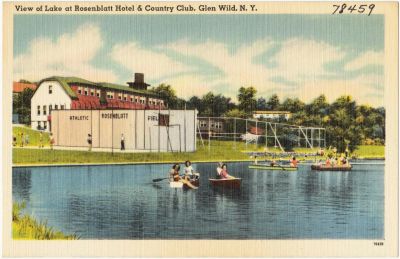
As Jake Ehrenreich points out, survivors cried at home and laughed in the Catskills. But unlike at other hotels, Wallenrod clearly had the Holocaust centrally in his mind during his wartime stint as writer–in-residence at the Rosenblatt Hotel in Glen Wild, later renamed the Coronet, and further on, the Empress.
Beshert the village of Glen Wild, Rosenblatt’s location, is linked to the very beginning of Jewish Catskills history. The first Jewish resort was started there in 1899 by John Gerson, whose granddaughter, Sylvia Ader, I was fortunate to interview. Gerson provided land for the Glen Wild shul in 1912 and it was built in 1923. Gerson had to know Louis Rosenblatt, whose hotel hosted Wallenrod, since Rosenblatt was a charter member of the Congregation. In the time between the 1913 incorporation of the shul and the 1923 opening, the congregation met in the living room of Shimon Jaffe, the rabbinical student they got to serve them - the thirteen or so families of Glen Wild had written home to their landsleit in the shtetl of Novo Alexandrovsk (later Zarasai), in Lithuania.
Their first task as a Congregation was to purchase land for a cemetery. The first grave was dug in the new cemetery in 1919, for a young mother who fell victim to the influenza pandemic that killed 50 million people worldwide in 1918-1919.
When I interviewed Reb Shimon’s sons Abe and Dave Jaffe in 1993, they spoke about how proud they were to have had two Torahsin their house for services, for ten years until the Glen Wild shul was built across the road from them. They still treasured the shul’shuge ledger-size minutes book that they kept in their house.
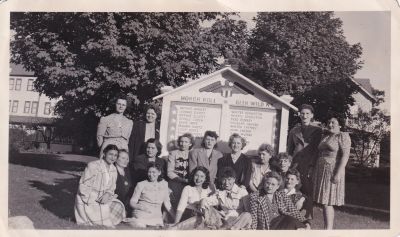
Abe’s daughter Naomi Jaffe owned the farm that her grandfather bought in 1919 (until 2025) 15 years after arriving in Glen Wild in 1904 where he raised poultry, and she thinks some of their property is actually on the site of Gerson’s boarding house. She gave me a 1944 photo of the Glen Wild Honor Roll plaque of the Glen Wild men who served in World War II, with the women of the Glen Wild Women’s Club standing and sitting in front of it. It is on the front lawn of Rosenblatt’s Hotel, clearly visible in the background, and links the GI’s sacrifice to fight Nazism with the historical importance of the hotel.
Wallenrod’s eloquent juxtaposition of genocide and pleasure made for a jarring, yet necessary, understanding. But more than that, Wallenrod told his story over the entire season of the Rosenblatt Hotel, from pre-season preparation all the way to post-season closing down. In the process, he recorded the life not just of a hotel, but of a people. Written in Hebrew between 1941-44 and first published in 1946 as Ki Fanah Yom (literally, Because the Day Turns), it was translated by the author into English and published by the Reconstructionist Press in 1957. Wallenrod, who left Belorussia for Israel in 1920, and came to the US in 1923, was part of a group of writers known as “Jewish Nationalists,” or “Hebraists,” who felt that modern Hebrew was the way to go, rather than Yiddish. He was an accomplished novelist and literary critic with a number of published books and studies on Hebrew literature.
We were fortunate to have many conversations with Wallenrod’s daughter Naima Prevots, who filled in lots of information for us on his life and work. She wrote a wonderful appreciation of him and commentary on the book in our Summer Haven book. She recalled that in the same year - 1955 - the English translation was published and Herman Wouk published, Marjorie Morningstar, first a successful novel and then a movie, in 1958. Naima remembers discussions about Reuben’s portrayal of the Catskills, and the value of his work in contrast to Wouk’s, including his concern for the assimilation that Work portrayed and that Wallenrod felt was dangerous to Judaism.
There was serious consideration of making Dusk in the Catskills into a Broadway play. Herman Wouk’s novel, as many of you know, centers around the rebellion of Marjorie Morningstar (née Morgenstern) against her family’s traditional expectations of her future life as Jewish wife and mother. She awakens to love and sexuality in the fictional South Wind adult camp in the Catskills, where she falls in love with Noel Airman, (née Ehrmann). Wallenrod was always critical of the sexuality and escapism that many Catskills guests sought, and because there was a push to transform Dusk in the Catskills into a “sexier” presentation, Wallenrod was not willing to make any changes.
Dusk in the Catskills follows hotel owner Leo Halper over the course of one full year, from the end of one summer season to the following autumn. During this period, the United States has entered the war in Europe. Halper, like Wallenrod, a Jewish immigrant from Eastern Europe, feels acutely and painfully aware of the atrocities happening to the Jews. At the same time, he loves his little Brookville Hotel and the beauty of the Catskills landscape. The book is prophetic in its mixing of past-present-and-future tenses to unfold the terrible story of the destruction of European Jewry. Wallenrod provides a clue to his prophetic role in the opening epigraph from Jeremiah: “Woe unto us! For the day declineth,/ For the shadows of the evening are stretched out.” Interestingly, the epigraph exists only in the English version, written after the war, and seems to send a warning back in time. The idea of warning one’s “flock” is a leading feature of the writer’s mission to his people and his nation, and to the surrounding world. Dusk in the Catskillsthen stands—with Jeremiah—as a prophet’s lamentation at the suffering of his people.
As a small hotel owner, Leo Halper has many bills to pay, and fewer visitors to his little hotel, which he fears he might lose. In conversations with his wife and family, he worries that the world of the Jewish Catskills is fading, and that the many immigrant writers and artists who depend upon him each summer season will lose that community. But the larger worry that grows within him, hidden from the others, is the Holocaust, the horrifying details about which he comes to know more and more during the course of the novel. He obsesses over the destruction of European Jewry, to which he feels existentially connected, and is roused to an almost feverish state of anxiety over his helplessness. He remembers fondly his early years on that landscape, a setting not unlike the Catskills. He remembers himself as a boy, running in the fields and swimming in the ponds of the old country, where many of his relatives remain. While these memories of his youth crowd his mind, he muses about the young people dancing in the hotel casino:
The heart knows well that there is another great wide, threatening world
outside you, but you are afraid to stop your dancing and think of that world.
Such knowledge may well break up the charm of the circle, it may well
break up your very being, all of you.
Halper refers both to the others and to himself with the pronoun “you,” carrying the tone of either a sermon or a rabbinical blessing or command. Like the leader of a congregation, Halper bears responsibility for his people and believes that they may not know what is best, or how to act, or how to see the deeper catastrophe underlying the Holocaust.
Among Halper’s greatest concern is what to do with the knowledge of the atrocities.
Like other Jews, he donates to the Jewish National Fund and other sources willingly, to help the new Israeli refugees and resettlement. In his many inner monologues, he struggles with feeling of satisfaction in being amidst the lakes and the mountains. But as soon as he feels grateful to have escaped the bleakness and death, fear and torture, he also feels shame for being safely away from the atrocities and guilt at the feelings of joy his life brings him. He is frustrated at not being able to help his family and friends in Europe.
As Wallenrod writes:
He was gnawed by the thought that he and Lillian were hiding here between the mountains in a sheltered den. There, across the mountains, terrible things were going on. People were being driven with whips in the cold and wind; little children stood helplessly on the side of the road like forsaken sheep, and near them and from above them came fearful shrieks through the storm. And he, Leo Halper, was hiding here between the walls of his house in the Catskill Mountains. It was awesome and shamefully pleasant in the shelter.
Halper’s experiences are further captured in these words:
People hid behind frost-covered windows, warmed their hands on iron
stoves, and listened to the sounds coming from the radio. The sounds
seemed to come in the storm. The window panes trembled, the trees
hummed, the voices on the radio told of terrible storms across
the mountains and the oceans. There people fled in terror, hid in snow pits;
men and women left the houses in which they had lived all their
lives and ran like frightened animals. There, across the mountains and
the oceans, wild beasts laughed and mocked and threatened, and here
a man sat and listened to the radio.
Wallenrod lost his father, sister, and her two children in the Holocaust. His book honors their memory even as it closely examines, through the loneliness of Leo Halper, the terrible crisis of being removed from one’s family as they faced their death.
Though tortured by an inability to act, his memories become a blessing, a monument to those people and places. Leo’s thoughts are private memory; but the book is shared and public, and openly expresses sorrow and sympathy in its lamentation. - Phil Brown

join us on october 18
OUR 20TH MARKER CELEBRATION!